My name is Mia. I was twenty-three and needed a job.
One morning, I saw an ad in the newspaper:
“Caretaker needed. One child. Must not fear old houses.”
It sounded strange, but something about it made me curious.
That afternoon, I took the bus to the address.
The house stood on a quiet hill outside the city.
The sky was gray, and the wind moved through the tall trees like whispers.
When I rang the bell, a man opened the door.
He was tall, with dark hair and tired eyes.
“You must be Mia,” he said.
“Yes, sir.”
“I’m Mr. Hale—Evan,” he corrected himself softly.
There was kindness in his voice, but also a sadness that filled the air.
Evan’s son, Liam, was ten.
He was polite but quiet—too quiet for a child.
When he showed me his drawings, I noticed something strange:
each one showed a woman in a white dress, standing by a lake.
“Who is she?” I asked.
“She’s Mama,” Liam whispered. “She watches us from her picture.”
I didn’t know what to say.
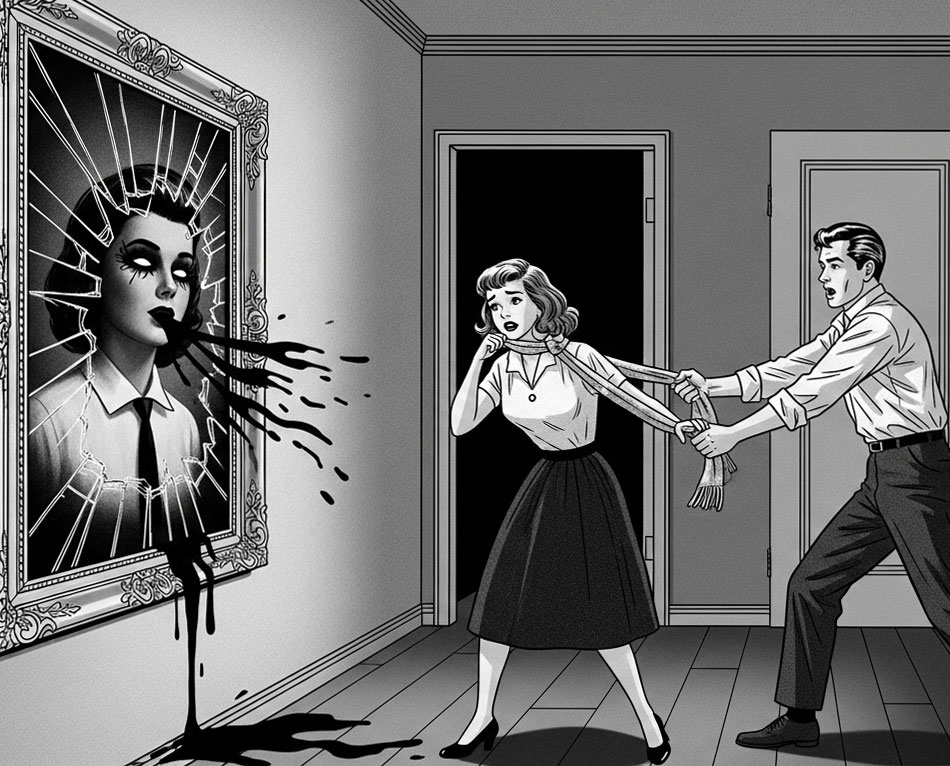
That night, as I walked down the hallway, I saw it—the painting.
A large portrait covered by a dark cloth.
But I could still feel something coming from it, like quiet sorrow.
When I reached out to touch the frame, Evan’s voice startled me.
“Please,” he said, “never touch that portrait.”
“Whose is it?”
“My wife’s,” he said simply. “Ava died two years ago.”
He turned away before I could say sorry.
(5) Silence and Laughter
The next weeks passed in calm silence.
I cleaned, cooked, and helped Liam with his homework.
Evan worked in his study all day, leaving before sunrise and returning after dark.
Then one evening, I heard laughter—real, warm laughter—from Liam’s room.
Evan was standing in the doorway, watching us.
He smiled for the first time.
“He hasn’t laughed like that in years,” he said quietly.
And in that moment, something small and fragile began to change.
One afternoon, a woman arrived.
Her clothes were elegant, and her eyes sharp as glass.
“I’m Serena—Evan’s sister-in-law,” she said coldly.
“You’re the new help, I suppose.”
She looked around the room, then at the portrait covered in cloth.
“You should know,” she whispered, “this house used to be full of light.
But Evan killed it with his silence.”
Her words stayed with me long after she left.
That night, rain crashed against the windows.
Thunder echoed through the empty halls.
When I passed the portrait, I saw light under the cloth.
I froze.
Slowly, I lifted the edge—just a little.
The woman in the painting looked alive.
Her eyes glowed softly, and her lips seemed to move.
“You don’t belong here,” she whispered.
“He belongs to me.”
I screamed. Evan ran in, pulling me away.
The portrait fell, the glass shattering across the floor.
In the quiet after the storm, Evan told me everything.
“Ava painted that portrait herself,” he said.
“It was her last work before she died. She believed it would hold her soul.”
“Her soul?” I whispered.
“She was sick. I didn’t stop her. I thought it was art, not a goodbye.”
He looked at me with pain and hope mixed in his eyes.
“Since that day, I’ve lived with guilt—and silence.”
Weeks passed.
The house felt lighter. Liam laughed again.
Sometimes I caught Evan watching me with the same quiet warmth as before.
One morning, he said,
“You brought color back into this house, Mia.”
“I only wanted to help.”
“You did more than help,” he said softly. “You made us live again.”
He took my hand.
“The portrait doesn’t haunt me anymore. It reminds me that love can return—in another form.”
Six months later, the old portrait still hangs in the hall,
but beside it now is a new one—painted by Evan himself.
It shows three people smiling: Evan, Liam, and me.
Sometimes, when evening light falls on both paintings,
the woman in white seems to smile too—peacefully, as if saying,
“Thank you.”
We can’t change the pain of the past,
but we can choose what grows in its place.
Sometimes, love returns — not to repeat the story, but to finish it right.